

What must NGOs do first to avoid a failing impact report?
Define your primary audience before writing a single word. Without clarity on whether you’re reporting to donors, boards, or communities, you’ll create muddled content that resonates with no one. Start by identifying who needs this report and what specific information matters most to them. When 70% of funders have reported they look for evidence of impact before giving, this targeting is essential.
Contents
You have one arrow – choose one target
You’ve spent months gathering data, documenting outcomes, and preparing financials. Your team has poured energy into showing the world what your organization accomplished this year. But there’s one question that keeps surfacing in planning meetings: Who is this report actually for?
Is it for major donors who funded your programs? For your board members who need governance oversight? For the communities you serve who deserve transparency? The honest answer for many organizations is “all of them” followed by a growing sense of unease.
Here’s the uncomfortable truth: trying to write one NGO impact report for everyone is the fastest way to reach no one. Organizations that attempt generic, one-size-fits-all reporting end up saying nothing much to everyone, struggling to achieve any behavioral change from any audience.
The solution isn’t more data or better design. It’s simpler and harder than that: define your primary audience before you write a single sentence.
Why audience definition makes or breaks your impact report
The real cost of audience confusion
When you don’t define your audience upfront, three things happen, and none of them are good.
First, your messaging gets muddled. You’ll try to satisfy everyone and satisfy no one. Donors need to see their specific contributions tied to measurable outcomes. Board members need governance accountability and financial evidence. Community members need proof your mission aligns with their values and genuinely benefits them. These are fundamentally different information needs. Cramming all three into one document creates confusion and dilutes your message.
Second, you waste massive resources. Here’s a sobering statistic: organizations typically spend 80% of their reporting time preparing and cleaning fragmented data. When you don’t know who you’re writing for, you can’t prioritize which data matters most. Your team ends up collecting everything “just in case,” then struggling to present it coherently.
Third, you miss opportunities for real influence. Different audiences need different proof points. Funders prioritize documented results and past performance showing effectiveness. Policymakers need data illustrating the extent and urgency of issues. Community members want tangible stories showing local relevance. Without audience clarity, you’ll provide the wrong evidence to the wrong people at the wrong time.
The stakes are measurable. Organizations that consistently produce clear, audience-focused impact reports see 15-30% increases in donor retention compared to those that don’t report consistently. One workforce development program saw renewal rates jump from 62% to 81% after introducing an effective, audience-aligned report format.
What actually happens without audience focus
Let’s get specific. Without defined audience priorities, your report will likely:
- Lead with organizational activities (“We served 500 families”) instead of donor-funded outcomes (“Your support enabled 500 families to secure stable housing”)
- Bury financial transparency in dense appendices instead of presenting it clearly for accountability stakeholders
- Use technical jargon that alienates community audiences while underwhelming board members who need governance metrics
- Include every data point collected instead of the specific evidence each audience needs to take their next action
The result is a document that technically contains information but strategically accomplishes nothing.
How to define your primary audience (a practical checklist)
Let’s fix this. Here’s how to identify and prioritize your impact report audience.
Step 1: Identify your core accountability stakeholders
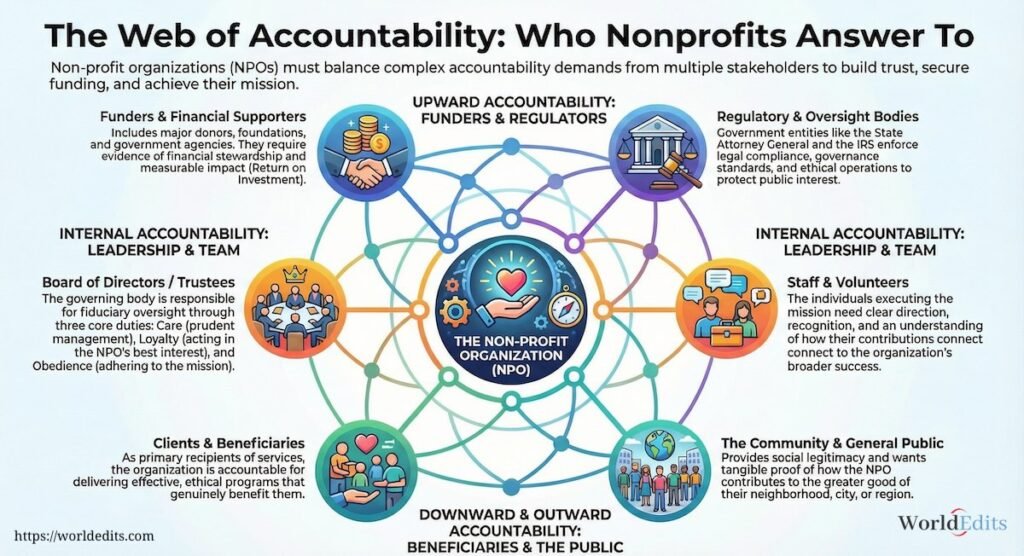
Non-profit accountability typically flows in three directions. Map your stakeholders accordingly:
Upward accountability
- Major donors, funders, investors
- Board members, regulators, oversight agencies
- Their need: Impact confirmation, ROI, governance accountability
Downward accountability
- Clients, community members, beneficiaries
- General public, policymakers
- Their need: Local relevance, values alignment, proof of benefit
Internal stakeholders
- Staff, employees, volunteers
- Their need: Recognition, mission connection
Step 2: Write your one-sentence audience statement
Force clarity by completing this template:
“This impact report primarily serves [specific audience type] who need [specific information] to [specific action/decision].”
Examples:
- “This impact report primarily serves major donors (giving $10,000+) who need personalized outcome data to renew annual giving at increased levels.”
- “This impact report primarily serves our board of directors who need financial oversight and program effectiveness metrics to fulfill governance responsibilities.”
- “This impact report primarily serves community stakeholders who need transparent proof of local impact to advocate for continued program funding.”
Step 3: Map content to audience needs
Once you’ve identified your primary audience, tailor your content strategy accordingly:
For funders/major donors:
- Lead with donor-funded outcomes, not organizational activities
- Provide personalized connections between specific contributions and targeted results
- Include transparent financial breakdowns showing program costs vs. overhead
- Close with forward momentum: future vision and specific renewal asks
For board members:
- Focus on governance accountability and compliance metrics
- Provide financial evidence of stewardship and risk management
- Include comparative data showing organizational performance trends
- Present dashboard-style summaries for quick decision-making
For community/beneficiaries:
- Use accessible language, avoid sector jargon
- Tell stories showing tangible local impact
- Demonstrate values alignment between your mission and community needs
- Create feedback mechanisms inviting continued engagement
Step 4: Consider engagement mindsets
Beyond demographics, consider the values and motivations driving your audience:
- Helpers (motivated by care and community): Use emotional appeals and people-focused stories
- Keepers (motivated by stability and tradition): Emphasize trust, legacy, and proven track record
- Captains (motivated by leadership and results): Use direct calls to action and clear metrics
- Artisans (motivated by creativity and innovation): Lead with visual storytelling and unique approaches
Focus each message on one primary mindset to avoid dilution.
Step 5: Segment by investment level
If serving multiple donor tiers, create segmented versions:
- Major donors ($10,000+): Personalized reports with granular metrics
- Mid-level supporters: Cohort-based impact summaries
- General supporters: High-level aggregated results
This approach honors different stakeholder investment levels while maintaining message clarity.
Quick fixes vs. structural fixes
Once you’ve completed your audience definition, assess whether your current draft needs surface edits or structural changes.
Surface fixes work when:
- Your core content targets the right audience but needs tone adjustments
- You have the right data but it’s presented in the wrong order
- Your executive summary doesn’t match your detailed content
You need structural fixes when:
- Your content tries to serve multiple audiences equally
- You’re leading with organizational activities instead of audience-relevant outcomes
- Your evidence doesn’t match what your primary audience needs to take action
Be honest: surface edits won’t fix fundamental audience misalignment. If you’ve written for everyone, you’ve written for no one. Sometimes the best path forward is restarting with clear audience parameters.
Why WorldEdits helps organizations get this right
This is where we need to be direct about what we do and why it matters.
WorldEdits isn’t a general editing service. We empower NGOs, development-focused organizations, and institutions with specialized communication to accelerate global good. We partner exclusively with organizations that have momentum toward positive outcomes for humanity and the planet.
That exclusivity means we understand the specific challenges you face with impact reporting.
Our human-in-the-loop process
We leverage AI smartly and securely for accurate information gathering and fact verification. But the final writing and editing? That’s human expertise all the way through. Why? Because knowing whether to lead with “Your gift removed barriers” versus “Your gift provided opportunity” requires sector experience. That seemingly small choice can improve engagement and 28% (clickthrough rates).
Specific service outcomes we deliver
When you work with WorldEdits on impact reports, here’s what changes:
- We help you write a clear audience statement before outlining content
- We structure reports aligned to your primary audience while creating accessible annexes for secondary stakeholders
- We transform organizational activity descriptions into donor-positioned outcome narratives
- We develop executive summaries calibrated for board-level decision-making
- We create community-facing versions using accessible language and local context
- We build dashboard-ready metrics presentations for governance audiences
The stability and track record that matters
WorldEdits is a brand of MacroLingo LLC, a registered corporate entity. That means guaranteed confidentiality, protocol adherence, and fiscal stability. In practical terms: we’re not freelancers who might disappear mid-project.
Our credentials back this up:
- 3,500+ edited manuscripts
- 1,200+ documents written
- Perfect on-time delivery record over 15 years
- ELS-certified leadership
These aren’t vanity numbers. They represent deep experience with high-stakes policy, research, and humanitarian reports where getting the audience right isn’t optional.
Three ways we can help
You don’t need to commit to a full report rewrite to start. We offer three entry points matching where you are in your process.
Your next steps: three ways to move forward
Option 1: Dig deeper (free assessment) Benefit: Get audience clarity and structural guidance before writing. What you receive: 30-minute consultation reviewing your work and seeing where it works and where it needs work. Request a free consultation
Option 2: Write (full report commission) Benefit: Hand off report creation to specialists while focusing on program delivery. What you receive: Complete impact report written from scratch, aligned to your defined audience, with iterative review cycles. Ask us about it
Option 3: Edit (audience alignment & line editing) Benefit: Transform an existing draft into an audience-focused document. What you receive: Structural reorganization, tone calibration, narrative strengthening, and comprehensive line editing. Request an editing quote
Not sure which option fits? Contact us. We’ll help you assess what your report needs most.
Frequently asked questions
Q: Can one impact report serve both donors and community audiences?
A: Not effectively. Create one primary report for your main audience, then develop targeted summaries or annexes for secondary audiences. This approach maintains message clarity while providing appropriate information to each stakeholder group.
Q: How do you measure impact for board audiences specifically?
A: Board members need governance-focused metrics: financial oversight ratios, compliance confirmations, risk management indicators, and comparative performance trends. Present these as dashboard-style summaries enabling quick decision-making rather than narrative-heavy explanations.
Q: What is a human-in-the-loop editing process?
A: It means using AI for research, fact-checking, and initial information gathering, while keeping human editors responsible for all final writing and editing decisions. This combines technological efficiency with irreplaceable sector expertise and judgment.
Q: Should we report quarterly or annually?
A: Most organizations use annual reports for general audiences, reserving quarterly updates for major donors (typically $10,000+ contributors). Match reporting frequency to stakeholder investment level and your organization’s capacity for quality production.
Q: What if our stakeholders have conflicting information needs?
A: Prioritize your primary audience for the main report. Then create targeted supplements: executive summaries for board members, community briefs in accessible language, detailed appendices for major funders. Segmentation solves conflicts that generic reporting can’t.
Let’s get this right and get you maximum impact
If you just need writing or editing for your NGO or organization’s case study. We can do it all for you. Please get in touch.