
When Your Company Restructures, You Get Severance. When Their Country Collapses or their Village is Bombed, Refugees Get Nothing.
You know what it feels like when the ground shifts beneath you. When the company announces layoffs. When your division gets eliminated. When the merger goes through and suddenly your role doesn’t exist anymore.
You spend weeks updating your resume.
You network.
You reach out to old colleagues.
You worry about your mortgage, your kids’ tuition, your identity outside of work.
You wonder if you’ll ever find something as good as what you had.
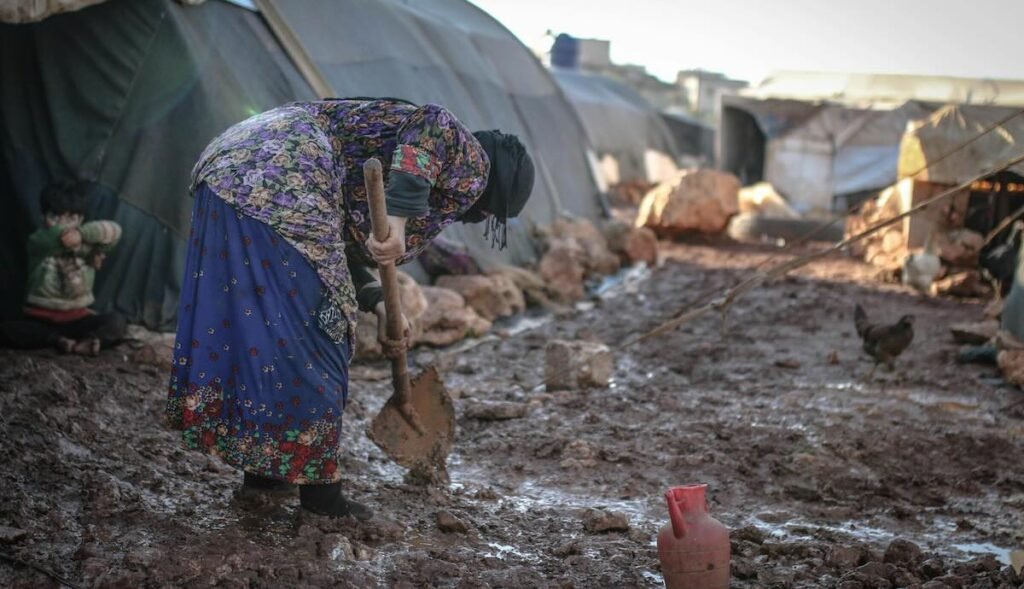
Now imagine all of that happening in one night. Imagine losing not just your job, but your home, your country, your legal right to exist where you are. Imagine having 24 hours to decide what fits in one bag. Imagine your professional credentials mean nothing anymore. Imagine your children asking why you can’t go home.
That’s Tuesday for 123.2 million displaced people worldwide.
Business leaders already understand struggle. They know what happens when the ground shifts. What they don’t see is how refugee crises mirror the professional and personal battles they face every quarter, just without safety nets, legal protections, or any way back.
The intent is not to guilt-trip you, it’s to help you help others. We’re working under that assumption – that, as human beings, especially in the West, we want to help, we have the means, but we don’t know how.
This is for you, as a business leader, to truly change the world beyond the often-empty promises of ESG.
Do you want to help? Read on.
Contents
Refugees and us: The parallel lives we don’t talk about
Professional identity dies hard
You built your career over decades. You earned your MBA. You climbed from analyst to director to VP. Your business card defines you at dinner parties. Your LinkedIn profile opens doors.
Then one day, it doesn’t. The industry shifts. The company pivots. Your expertise becomes obsolete overnight.
A Syrian engineer knows this feeling. He spent 15 years designing infrastructure. He trained at the top university in Damascus. He led projects worth millions. Then his city became a war zone. Now he’s in Berlin, and Germany doesn’t recognize his degrees. He stocks shelves at night and studies German during the day, trying to prove again what he already proved once.
A Rohingya doctor knows this feeling. She treated patients for a decade in Myanmar. She saved lives. She trained younger doctors. Then the military forced her people out. Now she’s in a Bangladesh refugee camp with no legal right to practice medicine. Her skills sit unused while people around her need medical care.
You lost your professional identity through circumstances. The difference is you get to rebuild in the same legal system, the same language, the same country. They start from zero in a place that doesn’t want to recognize who they were.
Family security keeps you up at night
You lie awake worrying about your family’s stability. Can you afford the house if the next round of cuts includes you? Will your health insurance cover your spouse’s surgery? Can you still send your kids to good schools?
These aren’t abstract concerns. They’re the weight you carry as a parent, as a partner, as the person responsible for other people’s safety.
An Afghan mother carries the same weight, multiplied. She got her family out of Kabul in August 2021. They’re in a Texas apartment now, and she’s grateful, but she lies awake every night. Her daughter needs asthma medication they can’t afford. Her son stopped talking after what he saw. Her husband’s engineering degree means nothing here, and he’s working two minimum-wage jobs. The rent is due in five days, and they’re $200 short.
She wants the same things you want. Safety. Stability. A chance for her kids to build normal lives. She’s working just as hard as you. The difference is she’s doing it in a language she’s still learning, in a system she doesn’t understand, with no safety net and no way back.
Bureaucracy makes you want to scream
You know bureaucracy. You’ve fought with health insurance companies over claims. You’ve navigated corporate expense policies that make no sense. You’ve waited on hold with the IRS. You’ve filled out forms that ask for the same information five different ways.
It’s maddening. It wastes your time. It makes you feel like the system is designed to wear you down.
Now multiply that by a thousand. Remove your ability to speak the language fluently. Remove your right to legal representation. Remove your ability to work while you wait. Add the knowledge that one wrong form, one missed deadline, one bureaucratic error means deportation.
That’s the asylum process.
A Congolese family waits three years for a hearing. They can’t work legally while they wait. They can’t travel. They live in limbo, checking their mailbox every day for the letter that will decide their future. They fill out forms they barely understand. They gather evidence of persecution that’s painful to remember. They wait.
You hate bureaucracy because it’s inconvenient. They hate it because it controls whether they get to stay alive in safety or get sent back to danger.
Starting over feels impossible
You’ve probably reinvented yourself at least once. You changed industries. You moved cities for a better opportunity. You started your own company. You went back to school.
It was hard. You questioned whether you made the right choice. You missed your old routine, your old colleagues, your old certainty. You felt like you were starting from scratch, even though you weren’t really starting from scratch.
A Venezuelan professional knows what starting from scratch actually means. She was a lawyer in Caracas. She spoke at conferences. She handled complex cases. Then the economy collapsed and the government became dangerous. She’s in Colombia now, living with relatives, trying to figure out how to become qualified to practice law again in a new country. She’s 42 years old and she’s starting over like she’s 22, except she has a family to feed and no time to ease into it.
An Eritrean entrepreneur knows this feeling. He built a successful business back home. He employed 20 people. He knew how the system worked. Then he criticized the government and suddenly he was a target. He’s in Sweden now, trying to navigate a completely different business culture, a completely different language, a completely different set of rules. He has to prove himself again from the beginning, except this time he’s doing it while processing trauma and grieving everything he lost.
You chose your fresh start. They didn’t. You had resources and connections. They often have neither. You could go back if it didn’t work out. They can’t.

Community is everything, until it’s gone
You know what it’s like when you move for work. New city, new company, no friends nearby. You miss your people. You miss the colleagues who understood your references. You miss the neighbors you’d have over for dinner. You miss having a place where you belong without having to explain yourself.
It’s lonely, even when the move was your choice and you know you can visit home anytime.
A South Sudanese teenager knows loneliness on a different scale. He grew up in a village where everyone knew everyone. His family had lived there for generations. He knew which neighbors to ask for help, which elders to respect, which friends would back him up. Then the violence came and his village scattered. He’s in a Ugandan refugee settlement now, living among strangers who speak different languages and follow different customs. He’s 17 years old and he has no community, no roots, no sense of where he belongs.
A Ukrainian family knows this loneliness. They had a neighborhood in Kharkiv where they’d lived for 30 years. They knew every shop owner, every teacher, every family with kids the same age as theirs. They had routines and traditions and a place at the table in their community. Now they’re in a small town in Poland, and everyone is kind, but they’re outsiders. Their kids don’t have friends who speak their language. They don’t know how things work here. They’re starting from zero in building the social fabric that makes life feel like living, not just surviving.
You miss your community when you’re away from it. They grieve theirs, because they can’t go back.
Why hollow ESG isn’t enough
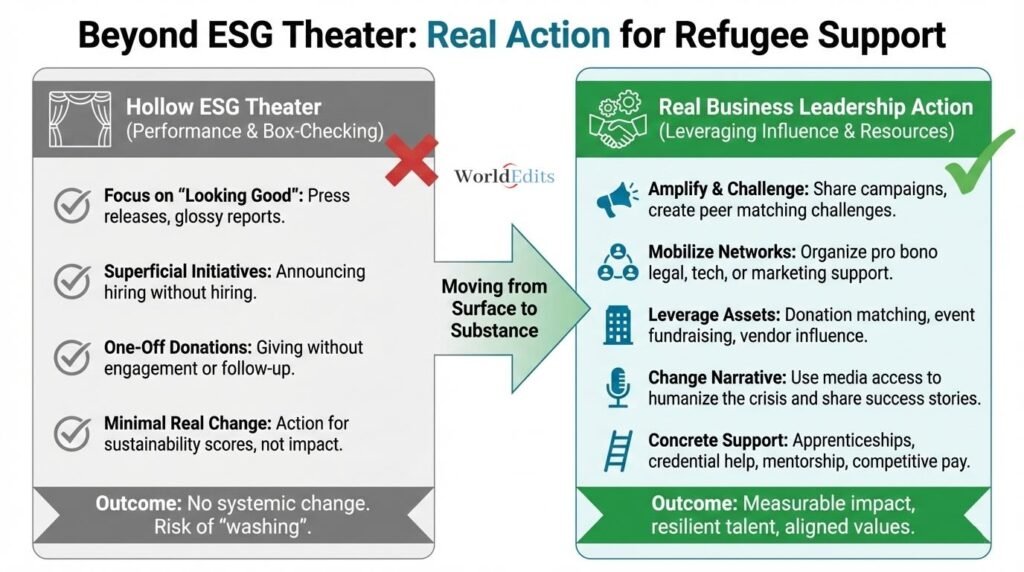
You’ve sat through the ESG presentations. You’ve seen the glossy reports about corporate citizenship. You’ve watched companies announce refugee hiring initiatives that sound good in press releases but don’t actually hire refugees.
You know what that is? It’s performance. It’s checking a box. It’s doing the minimum to look good without actually changing anything.
The difference between real action and ESG theater is simple. Real action costs something. Real action requires you to change how you operate. Real action means taking on risk and complexity because it’s the right thing to do, not because it improves your sustainability score.
Here’s what real action looks like:
A German manufacturing company doesn’t just say they support refugees. What they actually do is partner with refugee resettlement agencies to create apprenticeship programs that teach technical skills while people are learning the language. They assign mentors. They work with government agencies to get credentials recognized faster. They hire refugees into permanent positions, not just training programs that lead nowhere. They track whether those employees stay and grow in the company, not just whether they got hired.
That costs money. It takes time. It requires patience from managers and HR. It means dealing with paperwork most companies would rather avoid. They do it anyway because their leadership decided that their company’s values mean something beyond the quarterly earnings call.
A Canadian tech company doesn’t just donate to refugee causes. They actively recruit developers and engineers from refugee backgrounds. They work with organizations that help refugees get their credentials recognized. They offer language support and cultural mentorship. They create employee resource groups where refugee employees can connect and support each other. They pay competitive salaries, not “grateful to be here” wages.
That requires their talent acquisition team to work harder. It means their hiring managers need to look at non-traditional backgrounds. It means investing in onboarding and support. They do it because their CEO believes that lived experience makes their company better, and that hiring someone who rebuilt their life from nothing brings resilience they can’t find anywhere else.
These companies don’t do this for ESG scores. They do it because their leaders looked at the crisis and decided to treat it like it actually matters.
What business leaders can actually do
You don’t need a corporate foundation or a million-dollar budget. You need the willingness to use what you already have: influence, platforms, networks, and the ability to move quickly.
Amplify campaigns that matter
Refugee organizations run fundraising campaigns every week. Most of them struggle to break through the noise. You can change that in an afternoon.
When the International Rescue Committee launches an emergency appeal for Sudan, share it on your LinkedIn with your network of 5,000+ connections. When Women for Women International runs a campaign for Afghan women entrepreneurs, send it to your company’s email list. When a small grassroots organization in Greece needs $10,000 to keep their legal aid clinic running, post it and challenge five other CEOs to match your donation.
Your voice reaches people who trust you. Your endorsement gives credibility. Your network has resources that refugee organizations can’t access on their own.
A fashion executive with 50,000 Instagram followers can drive more donations in 24 hours than a refugee organization can in a month of posting. A finance industry leader with relationships across Fortune 500 companies can open doors that smaller nonprofits can’t open themselves. A tech founder with media connections can get a story covered that changes the narrative.
Use the platform you built to point it at something that matters.
Create challenge campaigns that move fast
You know how competition motivates business leaders. Use that.
Pick a refugee organization doing work you respect. Commit $25,000 and challenge four peer CEOs to match it within 48 hours. Make it public. Tag them. Create urgency.
When those four match it, you’ve generated $125,000 in two days. When they challenge their networks, the number grows. Suddenly a grassroots legal aid organization that was struggling to make payroll has the funding to expand their services.
This works because it leverages pride, competition, and the desire to be seen as a leader who acts. It works because the time pressure creates momentum. It works because business leaders respect other business leaders who put their money behind their words.
A real estate developer in Toronto did this last year. She committed $50,000 to a refugee housing initiative and challenged her industry peers. Within a week, nine other firms joined. They raised $500,000. The organization was able to house 23 families. It started with one person willing to go first and create the challenge.
Mobilize your professional networks strategically
You have relationships that refugee organizations will never have. Use them.
If you’re in law, organize 20 corporate attorneys to donate 10 hours each to asylum cases. That’s 200 hours of pro bono legal support that costs you nothing but coordination. Organizations like Asylum Access and the International Refugee Assistance Project can connect you to cases that need exactly that help.
If you’re in tech, mobilize your network to build digital tools for refugee services. A volunteer team of developers can create intake systems, translation tools, or case management software that small organizations can’t afford to buy. Code Your Future does this by training refugees to code, then connecting them to projects.
If you’re in healthcare, connect refugee health organizations with your network of doctors willing to volunteer. Partner with organizations like International Medical Corps or local refugee health clinics to coordinate specialists who can donate time.
If you’re in marketing, offer your agency’s services to help refugee organizations tell their stories better. Most grassroots groups have powerful work and terrible communications. You can fix that in a weekend.
The value isn’t just the service. The value is the network effect. When you mobilize your professional network, you’re creating relationships between high-capacity professionals and under-resourced organizations. Those relationships compound over time.
Leverage your corporate platform for immediate impact
Your company has assets that refugee organizations can’t access: employee networks, customer bases, vendor relationships, event platforms, newsletters, and conferences.
Use them.
Add a donation option to your next company-wide email. Ask employees if they’ll donate $10 from their next paycheck, with the company matching it. A company with 500 employees can generate $10,000 in 24 hours if 50% participate and you match it.
Turn your next corporate event into a fundraising moment. If you’re hosting a conference with 200 industry leaders, add a refugee organization as the beneficiary. Ask attendees to donate their coffee budget. Mention it in your opening remarks. Put a QR code on every table. You’ll raise $5,000 without disrupting the event at all.
Use your vendor relationships to create pressure. If you’re negotiating with suppliers, ask which ones support refugee employment or donate to refugee causes. Make it clear that matters to you. You have buying power. Use it to shift how companies think about their responsibilities.
Partner with GlobalGiving, Network for Good, or USA for UNHCR to create a company-sponsored rapid response fund. When a crisis hits, your company can mobilize donations instantly through a pre-existing infrastructure. Your employees want to help; they just need the easy pathway you create.
A consulting firm in Boston did this during the Ukraine crisis. They set up a partnership with a refugee organization in Poland. Every time the firm won a new client, they donated 1% of the contract value. They told their clients about it. Several clients matched the donation. They raised $300,000 in six months without creating a separate foundation or adding overhead.
Use your media relationships to change the narrative
You get calls from journalists. You speak at conferences. You write LinkedIn posts that get shared. You have access to media that refugee organizations don’t.
Use it to shift how people think about refugees.
Stop letting the refugee crisis be an abstract political debate. Make it concrete. When you’re interviewed about business trends, mention the refugee developer your company hired who’s now leading a project. When you speak at a conference, share what you learned from working with a refugee entrepreneur who rebuilt a business from nothing. When you post on LinkedIn, tell the story of how a refugee employee’s perspective changed your company’s approach to problem-solving.
Make the crisis real for people who only see it as numbers on the news.
A biotech CEO did this well last year. She was interviewed by a business publication about innovation. She spent half the interview talking about how her company’s partnership with a refugee STEM program brought in talent they couldn’t find anywhere else. She made the business case clear that refugee professionals bring resilience, adaptability, and problem-solving skills that come from rebuilding their lives under impossible conditions. The article got shared widely. Three other companies in her industry reached out to learn how to replicate the program.
That’s how you use media access to create change.
The numbers tell the story
At the end of 2024, 123.2 million people worldwide were forcibly displaced as a result of persecution, conflict, violence, human rights violations and events seriously disturbing public order. This represents an increase of 7 million people or 6% compared to the end of 2023.
It’s a stark breakdown…
- 42.7 million refugees under UNHCR and UNRWA mandates
- 68.1 million internally displaced people
- 7.2 million asylum seekers
- 4.4 million stateless people
69% of all refugees originate from just five countries: Syria, Afghanistan, Sudan, Ukraine, and Myanmar. 67% of refugees are hosted in neighboring countries, and 73% live in low- and middle-income countries. Of course, with the latest war of aggression, political upheaval, or climate crises, these numbers can change.
What the numbers don’t show is that more than half of the 36.4 million refugees registered with UNHCR live in countries where they have restricted access to formal employment. These barriers can be legal (employment bans, limitations on freedom of movement), social (lack of local language skills, networks, and recognition of foreign credentials), or administrative (high fees for work and residence permits, unclear local directives).
The credential recognition crisis is real. Foreign-educated professionals face skepticism about their training, prohibitively complex and expensive recertification processes, and systemic bias that pushes them into jobs far below their skill level. Language proficiency is indicated to be more important than any other variable in seeking job recruitment, yet refugees often can’t access quality language training while working survival jobs.
The result is that refugees are twice as likely to be unemployed compared to immigrants with similar backgrounds. In Australia, only 38% of refugees are employed, with 10% unemployed and 50% not in the labor force, compared to a national unemployment rate that hasn’t exceeded 6% in 15 years.
These are systems problems. And business leaders can fix systems.
Organizations doing the work
Some organizations operate at massive scale. Others work in neighborhoods. Both matter. Here’s where to focus your support.
Major impact organizations
UNHCR (UN Refugee Agency) coordinates global refugee response. They operate in over 130 countries. They provide shelter, legal protection, and basic services to millions. When a new crisis emerges, they’re often first on the ground. Your corporate partnership can fund emergency response teams or long-term resettlement programs.
International Rescue Committee (IRC) works in more than 40 countries and 26 U.S. cities. They provide everything from emergency relief to long-term integration support. Their programs include job training, legal services, health care, and education. They’re large enough to absorb significant funding and deploy it quickly. In 2024, the IRC reached 36.5 million people in countries affected by crisis.
Refugees International focuses on advocacy and policy change. They don’t deliver direct services; they fight for better policies that help all refugees. If you want your influence to affect systems, not just individuals, support their work. They don’t accept government or UN funding, which allows them to speak freely and independently.
USA for UNHCR mobilizes American support for refugee causes worldwide. They make it easy for U.S. companies to contribute to global refugee response. They handle the complexity of international funding.
Women for Women International specifically supports women survivors of conflict and displacement. They provide job training, rights education, and small business support. Women refugees face unique dangers and barriers; this organization addresses those directly.
Mercy Corps works in fragile states and conflict zones. They focus on economic opportunity and community stabilization. They help refugees and displaced people rebuild livelihoods, not just survive.
International Organization for Migration (IOM) is the leading intergovernmental organization promoting humane and orderly migration. They provide services and advice concerning migration to governments and migrants alike.
Grassroots organizations making daily impact
RefugePoint identifies and protects the most vulnerable refugees, the ones who fall through the cracks of official systems. They work in Africa and Asia to get people into resettlement pipelines. They’re small enough that a $50,000 corporate donation transforms their capacity.
No One Left Behind supports interpreters and other Afghans and Iraqis who worked with U.S. forces. These are people who risked their lives helping American soldiers and now face retaliation. They need legal help, resettlement support, and job connections. Your company might need their skills.
Code Your Future trains refugees and asylum seekers to become developers. They provide an 8-month program that turns people with no tech background into employable programmers. If your tech company needs talent and wants to support refugees, this is a direct pipeline.
Refugee Investment Network connects refugees with capital and business support to start or grow enterprises. They treat refugees as entrepreneurs, not charity cases. If you’re in finance or venture capital, this is where your expertise matters most.
Karam Foundation focuses on Syrian refugees. They provide education, development, and innovation programs. They operate in Syria and in refugee-hosting countries. They’re founded and led by Syrians. Your support goes directly to people who understand the community’s needs from lived experience.
Alight (formerly American Refugee Committee) works in 17 countries providing health care, clean water, shelter, and protection. They’re big enough to operate at scale but agile enough to respond to emerging needs quickly.
Jesuit Refugee Service operates in 56 countries. They accompany, serve, and advocate for refugees. They work in some of the most difficult and dangerous contexts. They focus on education, livelihood support, and legal protection.
Asylum Access provides legal aid to refugees. Most refugees can’t afford lawyers, and most asylum systems are impossible to navigate alone. This organization trains lawyers and paralegals to provide free representation. Your law firm can partner with them directly.
International Refugee Assistance Project (IRAP) is a virtual public interest law firm that provides free legal services to refugees and displaced people. They’ve won court victories that opened and expedited pathways to safety in the U.S.
International Medical Corps provides health services in crisis zones. They train local health workers, treat emergencies, and build sustainable health systems in refugee-hosting communities.
Refugee Council USA is a coalition of U.S. refugee organizations. They coordinate advocacy and share best practices. If you want to understand the U.S. refugee landscape quickly, start here.
What happens when leaders actually lead
You’ve read this far. You know what the parallels are. You understand that refugees face the same fears you face, just without the safety nets, the legal protections, or the ability to return to normal.
The question isn’t whether you care. The question is whether you’ll do something about it.
Use your actual power: your platform, your network, your influence, your company’s resources. Treat the refugee crisis like the crisis it is.
You can launch a campaign tomorrow. You can mobilize your network this week. You can partner with a refugee organization next month. You can change your hiring practices this quarter.
The refugees who need help aren’t abstractions in news reports. They’re the engineer who lost everything but kept their skills. They’re the entrepreneur who’s rebuilding from scratch. They’re the parent who’s fighting to keep their kids safe. They’re the professional who’s trying to prove all over again what they already proved once.
They’re people who understand the struggles you face because they’re facing worse versions of those same struggles, with less help and higher stakes.
The only difference between your hard times and their crisis is luck and circumstance.
You can’t fix the entire refugee crisis. But you can use your influence to change outcomes for specific people in measurable ways. You can fund the organizations doing the work. You can open doors that are closed to them. You can use your voice to make their needs visible.
Lead with conscience.
Want to discuss how your company, or you personally, can make real impact?
If you’re ready to move beyond ESG theater and create actual change, let’s talk about what’s possible with your specific resources and network.
We work with leaders who want to align their influence with their values. Let’s discuss how your company can turn concern into measurable action.
WorldEdits is not an NGO and it’s not involved in on-the-ground work. We’re a writing, editing, and content company that assists such organizations. We also work with corporations that want to make a difference and don’t just want to puff up their annual reports with so-called ESG accomplishments.