

📌 Three Takeaways:
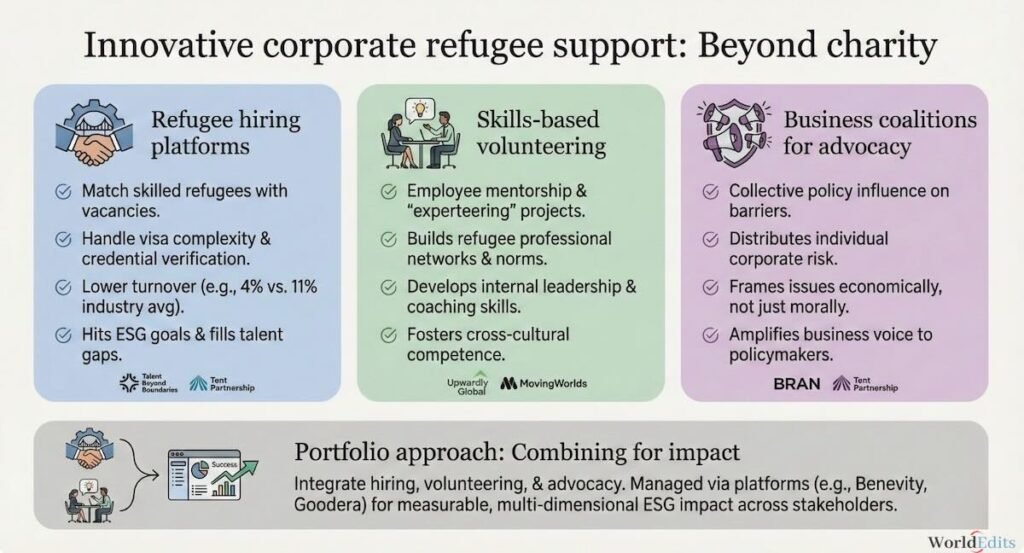
- Refugee hiring platforms address talent shortages while yielding 4% turnover rates (vs. 11% industry average in manufacturing)
- Skills-based volunteering develops employee coaching capabilities while connecting refugees with professional networks
- Business coalitions provide frameworks for policy advocacy without requiring companies to take public positions alone
Writing donation checks addresses symptoms. The platforms below connect companies with skilled refugees to fill vacancies, facilitate employee mentoring that develops internal leadership, and coordinate policy advocacy through business coalitions. Each addresses specific operational needs while supporting refugee integration.
How companies solve talent shortages through refugee hiring
Thousands of engineers, healthcare workers, and tradespeople with professional experience sit displaced in refugee camps and host countries. A Syrian mechanical engineer has the technical knowledge to work in engineering. An Afghan nurse understands nursing. What they lack are work authorization, professional networks in new countries, and employers willing to navigate visa complexity.
Talent Beyond Boundaries (TBB) operates as intermediary between companies with unfilled positions and credentialed refugees who possess the needed skills. TBB maintains a pre-screened talent pool, verifies credentials, and handles work-based visa processing that typically blocks refugee employment.
The mechanics: Companies define talent needs and submit job descriptions. TBB matches qualified refugees from their database and manages visa applications for work-based migration. The platform handles legal complexity that internal HR departments don’t have capacity to navigate. Employers gain access to motivated professionals. Refugees gain self-reliance through employment rather than aid dependency.
Retention rates support the business case. Research from the Fiscal Policy Institute shows that in manufacturing, refugee employee turnover hits approximately 4% compared to an 11% industry average. People who’ve overcome displacement don’t leave for marginal raises. The stability matters to them.
Hiring refugees also addresses ESG metrics and diversity goals that investors and regulators increasingly track. Companies fill chronic vacancies, reduce hiring costs through better retention, and demonstrate tangible social impact.
The Tent Partnership: Mobilizing 500+ companies for economic integration
The Tent Partnership for Refugees, founded by Chobani CEO Hamdi Ulukaya, represents the largest business coalition committed to refugee economic integration. Over 500 member companies focus on hiring, training, and workplace integration rather than traditional philanthropy.
According to Tent’s 2023 European Business Summit, member companies including Amazon, Hilton, and Pfizer pledged jobs and training for over 250,000 refugees. These commitments include recruiting infrastructure, training budgets, and executive accountability, not pilot programs.
Tent provides members with practical support: hiring toolkits that outline refugee recruitment processes, legal guidance on work authorization across jurisdictions, case studies from peer companies showing what works, and connections to refugee service organizations for candidate sourcing. The coalition approach gives companies peers to learn from and reduces the risk of being the sole corporate voice on a contentious issue.
The organization remains deliberately unaffiliated with political movements, focusing exclusively on employment outcomes. Supporting Tent means supporting refugee hiring and training, not taking positions on immigration policy or partisan issues. This distinction matters for multinationals navigating different political climates across markets.
Member companies gain access to overlooked talent pools while building employer brands with younger demographics who increasingly expect corporate social responsibility. The participation signals values without requiring public policy stances that might alienate stakeholders.
Skills-based volunteering builds internal capacity
Many refugees possess professional credentials and work experience but lack the networks and cultural fluency to navigate hiring in new countries. An Iraqi accountant understands accounting principles but doesn’t know how to translate credentials to U.S. equivalents or present experience to American hiring managers. A Syrian software developer needs someone to review their GitHub portfolio and suggest how to position projects for Canadian tech companies.
Upwardly Global connects corporate employees with refugee professionals for structured mentorship. An HR manager might spend an hour weekly helping a refugee understand U.S. workplace norms. A marketing director might conduct mock interviews. A software developer might review a refugee engineer’s portfolio and suggest presentation improvements.
The time commitment stays manageable at 1-2 hours weekly for 3-6 months. Upwardly Global provides structure, trains mentors, and tracks outcomes. This makes participation feasible for busy professionals while ensuring refugees receive consistent support.
For companies, this develops employees’ coaching capabilities. Mentors practice giving constructive feedback across cultural contexts, strengthen communication skills, and build empathy that translates to managing diverse teams. Many participants report that mentoring refugees teaches them more about cross-cultural communication than formal training programs.
MovingWorlds offers more intensive “experteering” where professionals spend weeks or months on skills-based projects with social enterprises and NGOs. Companies including Microsoft, SAP, and Unilever send employees on these pro bono assignments. For example, an engineer might spend three months helping a clean-energy startup in a developing country, or an HR manager might help a refugee entrepreneurship NGO improve operations.
These placements function as leadership development. Participants gain exposure to emerging markets, practice working with limited resources, and develop problem-solving skills in challenging contexts. Many return with renewed sense of purpose and implement socially conscious initiatives in their companies.
For Japan-based executives, Cross Fields’ Corporate Volunteering Program sends Japanese employees to work with NGOs and social enterprises across Asia for 2-12 months. Cross Fields matches volunteers’ expertise (IT, marketing, product design) with host organizations’ needs. Companies like Panasonic and Hitachi use this program to develop globally aware, purpose-driven leaders while contributing to social issues across the region.
Business coalitions provide safe policy advocacy
The Business Refugee Action Network (BRAN), incubated by the International Rescue Committee alongside Virgin, Ben & Jerry’s, and The B Team, allows companies to collectively advocate for refugees. Member companies don’t just hire refugees, they collaborate on pilot projects testing new integration models, share best practices on credential recognition and workplace inclusion, and collectively engage policymakers on barriers to refugee employment.
The collective voice approach offers advantages over individual action. It distributes risk, no single company becomes the face of a potentially controversial position. Policymakers take coalitions more seriously than individual firms. Executives who personally support refugee integration but work in politically diverse organizations gain air cover to participate without putting their company on the line alone.
BRAN focuses on business-led solutions rather than ideological positioning. When advocating for faster work permit processing, they frame it around labor market efficiency and economic growth, not humanitarian obligation. This pragmatic approach resonates with policymakers focused on economic outcomes.
Coalition membership provides a measured approach for executives worried about stakeholder blowback. You’re joining peer companies to address a workforce challenge, not leading a crusade. The framing matters when communicating these initiatives to boards, investors, and customers with varied political views.
WorldEdits creates policy briefs and explainers that help organizations articulate positions on refugee employment to boards, investors, and stakeholders without triggering defensive reactions.
Portfolio approach: Combining hiring, volunteering, and advocacy
Companies combining multiple engagement modes create measurable ESG impact across different dimensions. A company that hires refugees through Talent Beyond Boundaries gains firsthand experience with barriers those employees faced, which makes their advocacy through BRAN more credible. Employees who mentor refugees through Upwardly Global often become internal champions for refugee hiring, building cultural support for integration programs.
The portfolio model addresses different stakeholder interests. Investors and board members respond to talent solution narratives backed by retention data. Employees, particularly younger ones, engage with mentorship opportunities that develop their skills. Customers and communities notice companies advocating for fair policies through coalition work.
Measuring impact becomes more robust with multiple engagement types. Track hires, retention rates, time-to-productivity for refugee employees, volunteer participation rates, skill development among mentors, and policy outcomes from coalition efforts. This data supports ESG reporting on refugee initiatives, stakeholder communications, and internal justification for continued investment.
Platforms like Benevity and Goodera help companies manage employee volunteering, charitable giving, and impact tracking through integrated systems. These tools make it operationally feasible to run refugee support portfolios without overwhelming HR and CSR teams.
Benevity provides industry-leading software for corporate purpose programs, used by many Fortune 500 companies. The platform manages employee donations (with matching funds), volunteer hour logging, team charity challenges, and impact tracking through one dashboard. After humanitarian crises, companies use Benevity to quickly rally employee donations and volunteers.
Goodera specializes in curating volunteering activities for corporate teams, partnering with 50,000+ nonprofits worldwide. The platform offers companies a catalog of interactive volunteer events, from in-office kit-building to virtual tutoring to outdoor environmental clean-ups, which can run in 100+ countries and 30+ languages with Goodera’s logistical support. Impact consultants help design year-round volunteering strategies aligned with company purpose goals, making employee engagement scalable.
Additional platforms expanding the ecosystem
Welcome.US offers a non-partisan framework for companies to sponsor refugee families, particularly Afghans and Ukrainians. Direct sponsorship includes financial support, housing assistance, and community integration. This model appeals to firms seeking visible, localized impact rather than participation in large coalitions. It’s more comprehensive than employment alone and can be more meaningful for employee engagement.
Regional initiatives address specific displacement contexts. Asia Climate Philanthropy Advisory and AVPN’s Climate Action Platform focus on climate displacement, recognizing that environmental migration will increase as climate impacts worsen. These Singapore-based platforms help business leaders and philanthropists mobilize capital for climate adaptation projects that address root causes of displacement.
1% for the Planet provides a framework for embedding environmental giving into operations. Member companies pledge 1% of annual revenue to vetted environmental nonprofits. While not refugee-specific, the model demonstrates how to make social impact a budget line item rather than an afterthought. Companies make support for environmental causes automatic rather than reactive.
B1G1 (Business for Good) enables small and mid-sized businesses to integrate micro-donations into daily transactions. Each sale or activity triggers a small contribution to vetted causes aligned with UN Sustainable Development Goals (clean water, reforestation, education). A consulting firm might pledge that every billable hour funds a tree planting. A retailer might give a few cents per sale to refugee education projects. B1G1’s subscription model ensures 100% of contributions reach charities, and businesses get widgets to visualize their cumulative impact.
Making it operational: From strategy to implementation
Start by assessing talent needs. Which positions consistently sit unfilled? Which roles require skills that refugee populations commonly possess? Work with Talent Beyond Boundaries to determine if refugee hiring could address specific vacancies. Request candidate profiles to understand what skills are available.
Evaluate employee capacity for mentorship. Do you have mid-career professionals who’d benefit from coaching practice? Are teams looking for volunteer opportunities beyond traditional charity? Partner with Upwardly Global to pilot mentorship with committed volunteers rather than forcing participation. Start small with 5-10 mentors and expand based on outcomes.
Consider risk tolerance on advocacy. If taking public positions on refugee policy feels premature, focus on hiring and volunteering first. Join coalitions like Tent for best practice sharing without external-facing advocacy. As you build internal experience and stakeholder support, escalate to more visible policy engagement through BRAN.
Budget realistically. Refugee hiring through TBB includes costs for relocation support, work visa processing, and integration resources beyond normal hiring expenses. Mentorship programs require staff time and training investments. Coalition membership involves annual fees and participation commitments. The returns come through retention, employee development, and ESG advancement, but the upfront investment is real.
Communicate pragmatically. Avoid performative announcements disconnected from substance. Don’t lead with moral framing that might alienate stakeholders who don’t share your perspective. Instead, communicate about talent solutions, employee development, and business results. Frame refugee hiring as addressing labor shortages. Position mentorship as leadership development. Present coalition membership as peer learning on workforce challenges.
Companies often struggle with how to write about refugees without sounding preachy or triggering defensive reactions. WorldEdits develops impact stories and case studies that resonate with diverse audiences, particularly for multinationals navigating varied political climates.
Why demographic trends support refugee hiring
OECD research projects working-age populations across member countries will decline by 8% by 2060. More than a quarter of nations will experience declines exceeding 30%. Labor shortages constrain growth across sectors.
Refugee populations represent working-age adults with skills and motivation at precisely the moment demographic decline threatens economic growth. Many possess professional credentials and work experience. They’re actively seeking employment and demonstrate high retention once hired. The 4% manufacturing turnover rate compared to 11% industry average means reduced hiring costs and preserved institutional knowledge.
Younger employees increasingly expect employers to address social challenges. Supporting refugees through substantive programs rather than token gestures demonstrates values alignment. Mentorship opportunities specifically appeal to mid-career professionals seeking purpose beyond compensation.
Global instability makes displacement ongoing. Climate change, political instability, and economic inequality continue displacing millions. Companies that build refugee integration capacity now develop organizational competencies that will matter increasingly over coming decades.
Moving forward
Start with one approach. Pilot refugee hiring in one department to test processes and measure outcomes. Test mentorship with a volunteer cohort and track both refugee placement rates and mentor skill development. Join a coalition as an observer to learn from peers before committing to leadership roles.
Build evidence internally before scaling or communicating externally. Track retention rates, time-to-productivity, hiring costs, and employee satisfaction with mentorship programs. Use this data to justify expansion to skeptical executives or board members. Document outcomes through structured case reports that demonstrate measurable impact to stakeholders.
The platforms exist. TBB provides hiring infrastructure. Upwardly Global and MovingWorlds facilitate mentorship and skills-based volunteering. Tent and BRAN offer coalition frameworks. Benevity and Goodera provide impact tracking systems. The infrastructure works. Companies of any size can participate.
Clear communications determine success
Refugee support initiatives fail when companies can’t articulate their approach to skeptical stakeholders. Boards want business rationale, not moral appeals. Investors need ESG data, not sentiment. Employees respond to authentic engagement opportunities, not performative gestures.
WorldEdits works with companies to develop communications that resonate across diverse audiences. We help translate refugee hiring programs into talent strategy narratives, frame mentorship as leadership development, and document measurable outcomes through case studies and impact reports. Our expertise bridges the gap between doing the work and communicating it effectively.
Contact us to develop communications that build internal support and external credibility for your refugee initiatives.